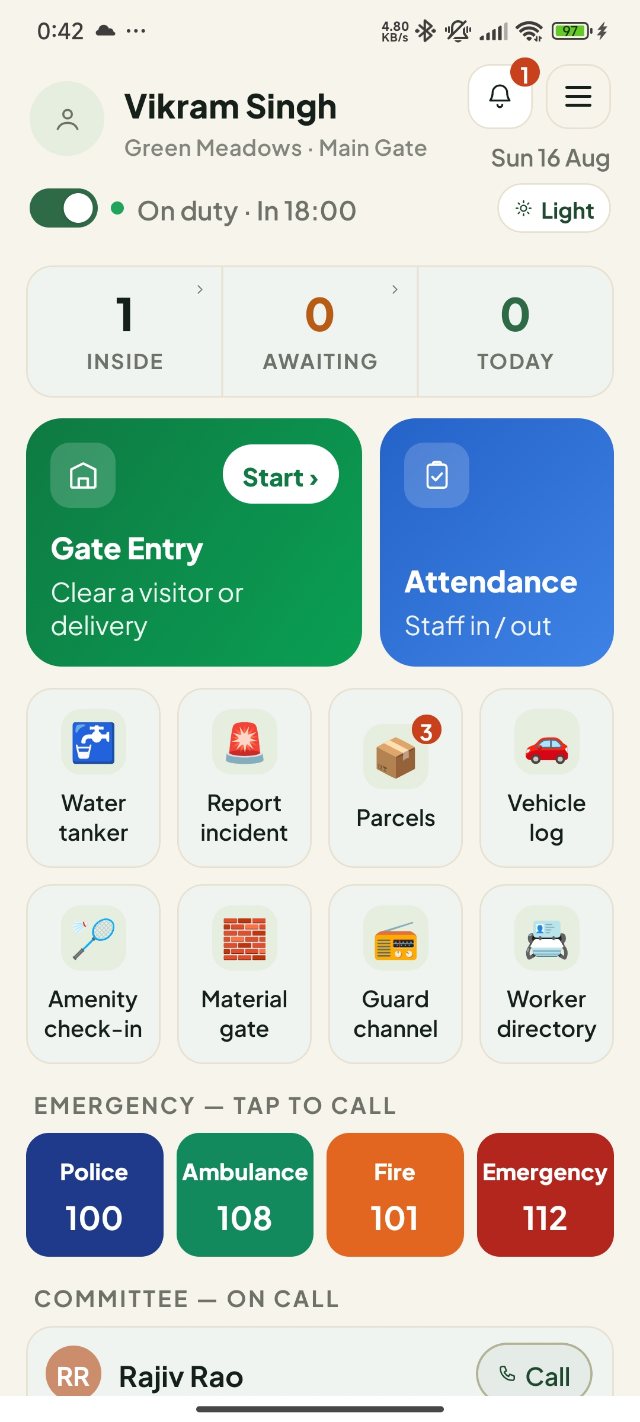
Zwangu's guard module replaces it — fast enough that a guard with one free hand actually uses it, and wired into everything the committee later needs to prove.
Guard module runs on Android 8 and up — the phone a security agency actually issues.
Camera opens on the entry screen. One tap, no framing, no upload wait — it queues if the network is poor.
Type 1204 or scan the resident's pass. Recent and expected visitors surface first.
Guest, delivery, staff, cab, vendor, material — one tap each, in the guard's language.
Approve or deny on their phone. Pre-approved names skip this entirely and the gate just opens.
The gate app isn't a shrunk-down admin console. It is the only screen in Zwangu we designed for one specific pair of hands.
This is what a paper register can never do: one log answers the resident, the committee and the auditor.
The gate app works on its own. These two integrations sit ready and are built on request rather than shipped by default — hardware you haven't asked for is hardware you shouldn't pay to support.
Plates read from the entry camera and matched against resident and expected-visitor vehicles, so a known car logs itself. Designed and parked: we build it when you ask, not before.
Controller integration is vendor-specific, so it's scoped to the hardware already at your gate — RFID or FASTag tags, existing barrier, existing wiring. Tell us the make and we integrate to it.
A Zwangu trainer works the first shift beside each guard, in their language, on their phone.
Both run in parallel until the head guard says stop. Nobody is forced to trust software on day one.
Agencies rotate staff. Onboarding a replacement is a profile and a walkthrough, not a training day.
Guards trained on site, paper register kept in parallel, and the visitor log exportable from day one.